Friday, November 8, 2013

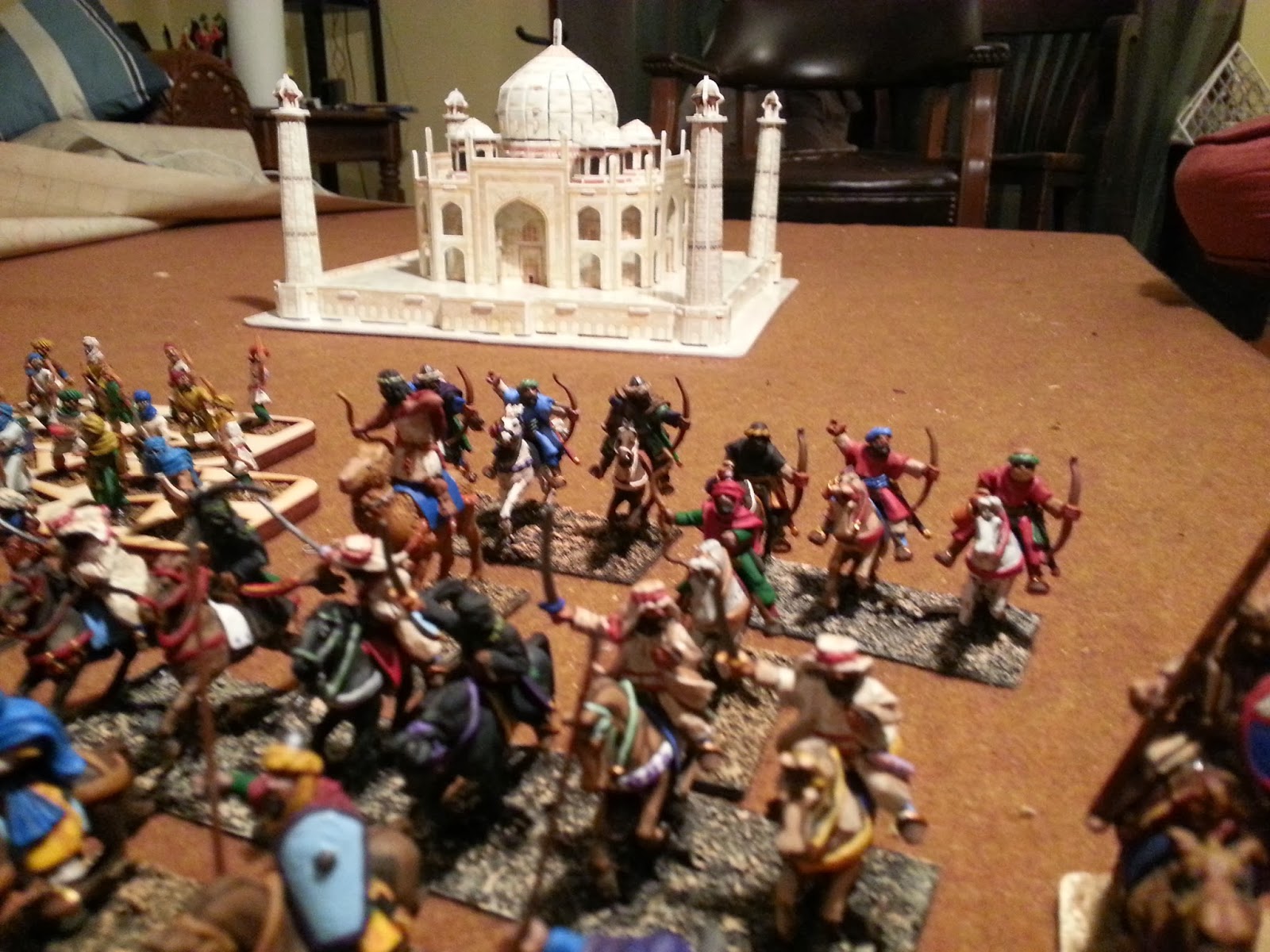
A Warning from the Caliph

In the name of God the all-powerful, the merciful, the compassionate, the incomprehensible; he who raises beggars up and lays sultans low; he who shattered the peaks and flattened the steppes; the architect of oceans and anthills, whose blessing is sunshine and honey sweet dew, and whose scorn is earthquake and plague, I speak. 
O Kings of the North, my spies relate that clumsy, creaking vessels full of what pass for soldiers in the lands of the unbelievers creep towards our shores. Woe betide them!
Their masters have told them that the lands of the Faithful are rightly theirs, and that they should board their rickety ships and take them by force. Can they believe it?
Know that these lands are peopled by men who love Truth, Heaven, and the Book. Know ye also that these men would gladly die to defend this truth, and feel no fear when they look upon your bristling spears. Know ye that the men of the South have spears of their own, yea, and sharp swords, and quivers of arrows, and stout mail, and swift horses and camels.

Although you are apostates and heathens, we feel some compassion for you as our fellow men and creations of God. Therefore we beseech you: Turn your lumbering barques and return to your freezing lands. Or come and stay briefly, as our guests. Let us teach you our ways: mathematics, poetry, bathing; and then return to your homes, richer not in looted treasure, but in knowledge and culture. 
If you thirst for war, consider this: you will die in this holy war. The sands will drink up your blood, jackals will gnaw your bones, and scorpions will make their homes in your eye sockets. Is that what you desire? The yellow haired, immodest, painted harlots that you love so well will mourn you briefly, and then take other men to bed. You will not pass down your swords to your sons. Consider it. 

If you are still committed to war, ask yourselves this: are you prepared to face a nation of warriors favored by God? Has there ever been a battle in which God has favored the wicked over the righteous? Or does not the God of the Prophet strike down every vainglorious king who ever dared stand against Him, and all of their lackeys besides?


 Do you imagine that your mail will deflect the truth? That your swords can parry destiny? That your shields can turn aside the wrath of the One True God?


I see now that there is no sense in you, that still you come. It saddens me -- but soon my sadness will turn to anger, for the anger of the righteous is like the sirocco, the desert wind that will sour the heathen, the idolator, the infidel from our lands.




Sunday, September 15, 2013

Greeks versus Celts, round 2

M's Celts and my Greeks had fought once before, and it's documented on this blog. That time, it had been a fairly even slog, with two tough front lines bleeding but refusing to break. Our last game, though, was a quick, decisive murder. Read on!
M's Celts: a ragged but vicious mob.

 My Greeks: ordered, disciplined warriors, the sword arm of civilization. In the back, the Golden Fleece.

 More Greeks.

 Keep an eye on that Greek medium cavalry.

 After a number of failed commands from the Celtic commander, I charge the medium cavalry into a warband which is still sitting on the Celtic starting line. This is risky; the warband is going to be rolling approximately as deadly a hand of dice as I am (med cav supported by a few light cav). BUT if my cav gets beaten, there was a good chance it would retreat, damaged, and still be of some use to me later on. If the foes lost the battle, they were likely to get driven off the table.

After a round or two, that was what happened. The dice went my way, the gamble paid, and in a round or two the cavalry had driven the warband off.
 
Now the cavalry had the position to threaten a second warband, this time in its flank. Still scary because they're doing this without support; the hoplites aren't in position yet.

 Now the phalanx clashes with the warband.


 Both of us are using the pig's head formation.


 My hoplites' toughness, especially that of these Spartans, gave me a minor advantage in the massed melee.

 In the upper right hand corner you can see that medium cavalry sweeping behind M's line. Engaging a phalanx to the front while cavalry hits you in the flank or rear is hopeless. It's this "hammer and anvil" approach that made Alexander unbeatable.

 M pulls off a nice tactical move here, smashing into my Spartans with chariots, and hitting them right on the flank when they're engaged -- essentially what I'd been doing to him for the previous three or four rounds. But the Spartans, being Spartans, do not break, and it's just too late for the Celtic chariots to turn the tide.

(Not pictured, three units of hoplites and a unit of slingers whose poor command checks kept them from ever getting involved in the fight. Mike suffered even worse than I from having his troops stand around listlessly.)

With the warbands falling back, I pull some hoplites out of rearguard and march them up to face the chariots head-on. At this point, hammer-and-anvil had eliminated so many warbands that the whole Celtic army had to withdraw.

The first clash, between cavalry and warband, pretty much sounded the Celts' doom, though M tried doggedly to turn it around. The battle would have been very different if the barbarians had shrugged off the first charge. After the match, we counted up our armies' points (neither of us had bothered to count points beforehand because we're just in it for the lulz and an opportunity to play with our toys. I think my army was worth 249 points and his was maybe 219, so I had been playing with an advantage (tainted victory!) He had been matching me warband-for-phalanx each game when we laid out our divisions, and neither of us had been considering that medium infantry are not equivalent to heavy infantry (espacially Disciplined, Elite, Stubborn heavy infantry like those Spartans). He should be getting an extra warband or chariot unit each game, which could really help these Celts. It'll be tough for me not to get my front line outstretched or flanked.

Friday, August 23, 2013

More Saracens

Members of the Richmond Leisure society haven't seen me in a few weeks. But I'm still out there, lurking, painting, looking forward to my next clash with the infidel. Behold: my growing army of Saracens.


I'd like to add some captions of badass Muslim war-cries but I'm afraid I'd end up using keywords that would land me on an NSA watch list. I'll just give you some oud music instead, to listen to as you click on and gaze at my pics. http://www.youtube.com/watch?v=pF-kgZf2nFI

This force is far from battle-ready because it is all foot soldiers and Saracen might derived largely from their fast, agile cavalry (mounted on mares!) And don't worry, my Frankish friends, I have plenty of horsemen, and they will be pretty enough for a 28mm scale battlefield soon. Meet me at Acre, at Edessa, at Jaffa. The streets will run with the blood of the unbelievers!

I'm looking to do some Middle Eastern city features & buildings, too. My results sculpting buildings in the past have been so-so. 

Wednesday, July 3, 2013

Saracens!

Looks like I'm going to be getting neck-deep into the Crusades in the near future. I'm planning to write a couple of semi-historical comics about the pilgrims' road to Jerusalem. And to go along with my new interest, why not paint a Saracen army? Here's 21 swordsmen/archers -- this army's going to have a lot of this sort of soldier, which I love, because I can take my position and arrow away at you all day, and if you feel like closing to fight with swords: hey, lucky you, we brought swords too. These guys' outfits might be a little too colorful to be historically accurate, but I don't care. Who wants to paint a hundred brown tunics? These are festive Saracens.


 Sometimes its fun to check out what army everybody else is building, and then build their primary opponents. Everybody likes to paint medieval knights, so everybody should be spoiling for a Crusade. Right? Nothing beats dying in the sand and having vultures eat your eyes.


Sunday, June 30, 2013

First, peep a couple of my Greek leader stands. On the right , the Golden Fleece. On the left, the Hippocampus. (Turns out, that's Greek for seahorse, or, to them "coiled horse". I didn't know that term during the battle, and I regrettably referred to this leader as "Captain Seahorse"). These are customized standards, the seahorse bought as a little charm or bead, the Fleece just some gold painted scrubbing pad and the ram's head off a Wargods of Aegyptus figure, all mounted on some assorted metal battle flags from Reaper, I think.
I love em. Gonna try to do one more with a Medusa head earring.

 Now, to the battle. The year is 500 B.C. The Greeks have spread their brand of civilization across the Mediterranean. To the far-flung west, the Hellenes have built a colony on the southern coast of what will one day be called France.

In the hills lurk the Celts -- unwashed, illiterate, and mistrustful of civilization. They look upon the fledgling city and they do not like what they see.

Let's see if they can wreck it.

Here's the table we played on, my 3 coffee tables pulled together, actually. Covered in white felt and with snowy outcroppings crafted by Chris W, it gave us a snowy double mountain pass. Does it snow on the French Riviera? Well, it was a little ice age.


 I joked that if the Celts could read, they'd know not to face Greeks in a mountain pass. Unfortunately Mike's chieftains were better than my strategoi at getting off those first few  commands and he got to hold a pass first. Slingers in front so that they could easily fall back in their loose formation when my men engaged them, they posed an obstacle that was tough to approach, tougher to dislodge. It was just the position that I wanted to occupy.

On the other flank, the Hippocampus phalanxes do lodge themselves right in the sweet spot between the tower and a scrubby hill (difficult terrain where formed units could not tread). My toxotoi (archers) are a little behind, but they're going to nestle up in the safety of those bushes.

The Celtic warbands stampede towards the pass.

On the right flank, my light cavalry wings around the far edge of the tower, too narrow a space for a unit in close formation. Right now they're just startling some slingers, which evade, but these guys in that space are going to prove extremely useful in a few rounds.


On the left flank, the Golden Fleece hoplites go for the glory and charge their barbaric foes. This combat was more interesting than I thought it would be. I hypothesized that the combat would be decided in a round: if the warband, with its amazing clash value, broke the phalanx, then the Greeks lose. If the hoplites stood, the Celts, with their worse sustained combat value and morale saves, would slowly get ground into hamburger.


Over the next couple of rounds, the Celts do begin to get the worse of this exchange. The meat grinder effect is going slower than I anticipated, and when the Celtic morale wavered, I didn't anticipate that they might give ground in good order. But they did, and this removed them from the meat grinder AND allowed them to  benefit from their high clash value again.


Here comes the Greek medium cavalry to save the day! Actually, these guys got stuck out of formation on the scrubby hill and could do nothing but hurl javelins at another warband.


Here's where we ended up -- my hippotes caught in the hills, my archers deliberately in the hills, both basically daring a warband to charge uphill a them ,while not being willing to charge the warband either. This basically tied the hands of M's warband and my horsemen. BUT in this pic you can see that my phalanx has pushed that warband back, abandoning the security of the pass. I'm not certain that the pass was all that desirable a position --it limited how many units could support a phalanx because I couldn't put anybody on its flanks. It did prevent me from GETTING flanked, though. And in the picture below, I manage to hit the enemy flank with those sneaky light cavalry --Thessalians? It tipped the balance between phalanx and warband and I finally broke one.

On the extreme left flank, a group of peltasts finally manage to sneak around the edge of a cliff after failing their command roles five more more consecutive times. Way to go, guys. You arrived way too late to contribute your meager attacks against an enemy who probably would have shrugged them off anyway. Fuckin' javelins.

We stopped playing around midnight. The battle wasn't decisive but I had the advantage in both position and kills. Celtic warbands v hoplites is NOT a fight that gets determined in one round and each round of combat was pretty close, so a couple of bad rolls could  have had my phalanxes rolling backwards while the warbands pushed me around the table instead. But that didn't happen, and for now, Massalia stays Greek.