Wednesday, August 26, 2015

Guns of August, in Williamsburg, VA. My game had no guns, but those of you who know me know how tedious I find the pops of powder compared to the ring of iron on bronze. This year, I would run a Trojan War scenario. In this scenario, as in the Iliad, Patroclus has donned the armor of the sulking Achilles, and been killed by Hector. Now the Greeks and Trojans scramble to recover the body of Patroclus and Achilles' armor. I used the Hail Caesar rules... sorta. 

The main difference here was that there were no Commander figures. Normally in HC, commanders aren't units and can't be targeted (they can add dice to other units in combat). In this scenario, each chariot (5 to a side) would combine the abilities of a commander (in command of 1 unit of infantry and 1 small unit of light infantry peltasts or skirmishers) and a unit of light chariot.

Another thing that was odd about this game was that there were no battle lines. Instead, at the game's start there were mini-conflicts all across the terrain: a Greek division facing a Trojan division in the NE, another in the NW, another in the SE, and in the SW, with Hector in the center and an unoccupied Greek band not far off. Hector was the closest to the marker for Patroclus' corpse, which would serve as the flag in this game of "capture the flag". You can see the H-shapes all across the starting board, each of which is one of these mini-conflicts.

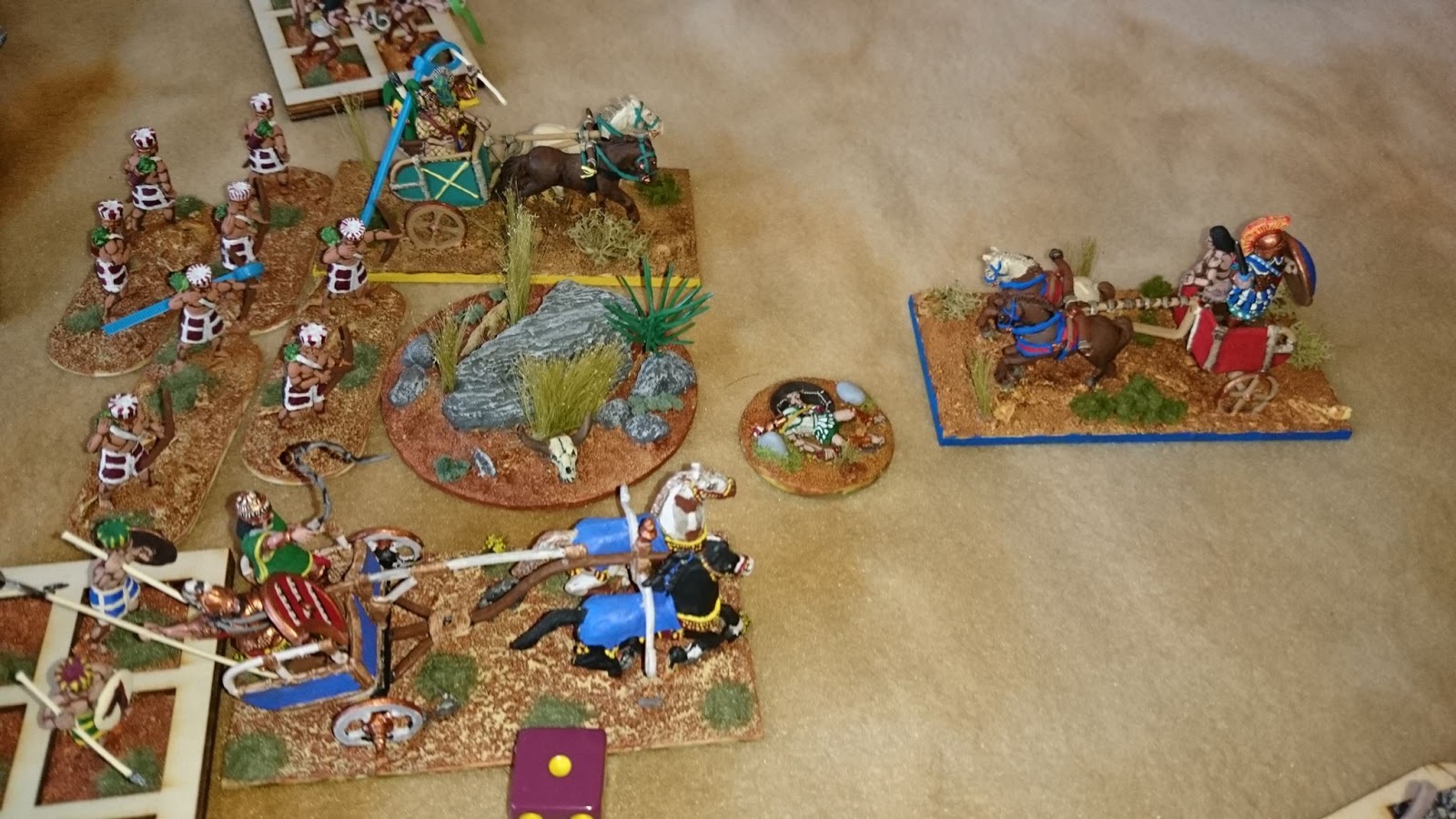
 A Mycenean standoff!


Here at the end we see a Greek chariot trying desperately to contact or at least shoot at the rear of Hector's chariot just before he makes it off the table. The attempt was not successful and the Trojans brought the body back inside the walls of Troy. Achilles is going to be pissed! 

This was the best HC game I have run, even with the funny rules. I had both HC newbies and HC veterans at the table and all said they enjoyed it. I realize now that I gave nothing to the Greeks to offset the advantageous position of the Trojans (Hector started right on top of the body) so I probably should have granted the Greeks the first move. I may run the scenario again.

Monday, August 3, 2015

These pics chronicle the playtest of a Hail Caesar scenario I intend to run at the Guns of August con at the end of this month. The game is set in the Trojan War, just after Hector kills Patroclus. Greeks and Trojans battle to recover Patroclus' corpse and the armor of Achilles, which he died wearing.


I tested some rules that were a departure from Hail Caesar. In addition to rules for carrying off Patroclus' body, I merged commanders with units of light chariots to create Homeric heroes. These were represented as a single chariot model, and therefore had some pretty massive clash values on a  narrow frontage. This did not turn out to be a major problem and it did convey the feel of a few heroes wreaking havoc among swarms of lesser men.


A problem I'm glad we ironed out in my living room rather than at the con was the mechanic of picking up and running with the dead body. Making a unit that gives ground drop Patroclus did not work well (it allowed one team to keep hold of the body). It will work better if any unit that forces the unit holding the body to give ground seizes the body itself.

You might notice that the Greeks in this scenario are hoplites, although that's very anachronistic to the Trojan War. I prefer to make them very distinct from the Trojans and those crested helmets are an easy identifier.


Thursday, June 18, 2015

Converting Freforge Mongols to Saracen mounted archers

Hey, friends, super long time no post. I just thought you'd like to see my conversion of Fireforge Mongols into Saracen mounted archers.

I wish I had a great artistic breakthrough here, but it's really straightforward. I just popped some extra heads I had from my Gripping Beast Arab spearmen and archers on the Mongol bodies and I was pretty much there. While I'm sure a cultural anthropologist would disagree, from a historical mini gaming perspective there don't seem to be any major costume features that separate Saracens from Mongols from the neck down. At least, as I painted these dudes, I completely forgot they were ever supposed to be Mongols,

 Yes, I realize that Gripping Beast does plastic Arab cavalry at about the same price point. Fireforge's Mongols appealed to me more. You get more scimitars with them. 

I dig these guys with their full head wraps.  Note that I made one of these dudes leaning as far back as possible to take a Parthian shot to the rear.

 I decided, since I ran out of fully-wrapped heads, that I'd do some more colorful riders wearing small turbans. I think the full-face wrap guys are Bedouins and the turbans are more urbanized Arabs or Seljuks.
 I didn't realize while I was assembling them that most modelers place a horse archer's quiver at his hip rather than on his back. That's too bad, because I like to model the pose of reaching back over one's shoulder to draw the next arrow. Can anybody speak to the historicality of quiver on back vs quiver on hip?


 Had to let this adorable figure get in on this post. He's a stray Castaway Arts infantryman. If you are an ancients/medieval 28mm wargamer and you don't know Castaway Arts you should really give them a look. They're Australian, but it's cheaper and faster to order stuff from down undah than you'd think... no worse than ordering from England (I'm located in Virginia).

Friday, July 4, 2014

The Battle of Cunaxa: Persians vs Persians!

401 BC. While the legitimate shah, Artaxerxes, has gone east to quell a revolt, his brother, Cyrus the younger sees an opportunity to fill the vacuum. He declares himself king, wins the loyalty of Asia Minor and the Levant. Getting word of Cyrus' mischief, Artaxerxes heads west with the royal guard (including the famed Immortals and some newly-painted heavy cavalry. Cyrus hires 10,000 Greek hoplites (whose story is chronicled in Xenophon's Anabasis) to match his brother's forces and heads west. They meet on the bank of the Euphrates, 40 miles from Babylon, near a little town called Cunaxa. That much is history. 

Last night I hosted and reffed this game for two history professors, Professor T and Professor D. The first to arrive at my house, prof T, took on the role of the firstborn son , Artaxerxes and prof D, when he got there, played the second born, Cyrus. 


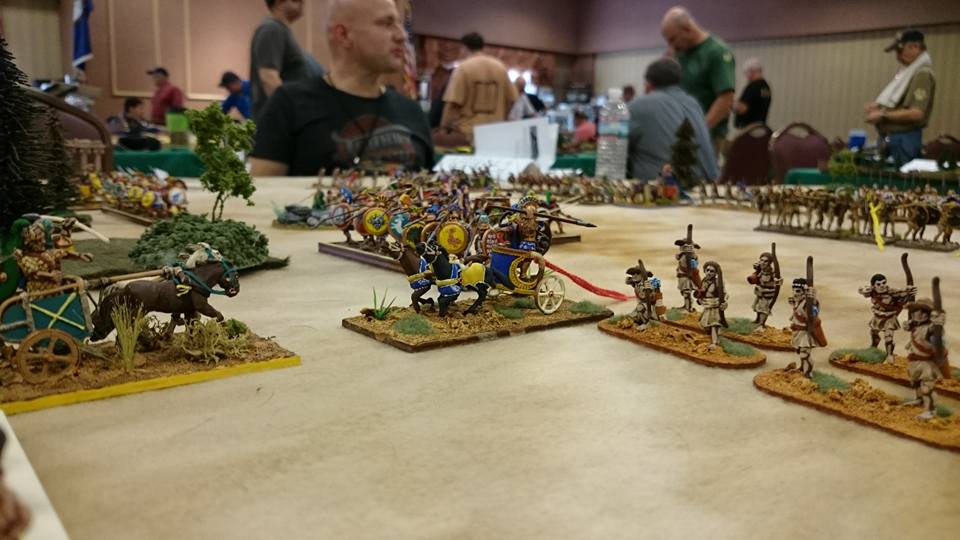
Here's our play area, not a bad bit of terrain if I say so myself. The sand is just a variegated, sort of tie-dyed looking brown/tan felt I bought at a fabric store. The river is tie dyed craft paper. There was no difficult terrain here, but I ruled that the Euphrates was deep and swift along this bank, and that any unit forced to give ground or withdraw into the river would be lost.


Cyrus (professor D) has a fantastic first shooting round, his bows and slings rolling sixes and triggering some pretty unlucky rolls from Professor T. Half of Artaxerxes' skirmishers are cut down before they finish lacing their sandals.

So Artaxerxes scrambles to make contact with the usurper's troops, light cavalry on his flank.

Nearer to the river, the (lesser, non-royal) commanders are having less luck with their orders -- the two sides, including Cyrus' hoplites and Artaxerxes' guard cavalry, just glare at each other.

Artaxerxes gains ground with a solid line: Indian subject levy, sparabara, and Immortals backed by elephants.

And Cyrus' takabara levies fall back.


But the would-be emperor strikes back with these scythed chariots. These one-shot weapons are going to annihilate a unit of sparabara and cripple the Immortals. "Immortal THIS, bitches!" squealed a man with a PhD.

With the sparabara down, the elephants more or less become Artaxerxes' front line.


A bit late to the (toga) party, the hoplites advance. Prof D was worried about them being so far from their barbarian allies. Turns out he needn't have been -- heavy infantry with long spears and phalanx formation is a tough package in Hail Caesar. They chopped through a unit of sparabara with really lovely salmon and turquoise outfits, I mean really lovely, just look at them. Anyway, they died. Even the heavy cavalry wasn't making a dent in Cyrus' phalanx.


On the far end of the fight, the brothers actually meet, Cyrus leading a unit of takabara and Artaxerxes among some subject infantry (both of these guys reduced to consorting with levy troops! They must have been desperate).


As Atraxerxes' levies retreat, both sides have seen a lot of casualties, but only Cyrus still has anything resembling a battle line.


And then Cyrus led a unit of takabara against an elephant. And some dice got rolled. And Cyrus got his fool head stepped on. In Hail Caesar, of course, every time your leader contributes dice to a battle, there is a small chance that he will die. And so he did; and with the death of Cyrus the question to succession was settled. (In real history, Cyrus's death in this battle abruptly ended the civil war. The Greek mercenaries offered their services to another Persian; they said that they could make him king, but he declined, because his blood was not noble enough). Professor D was kind of surprised by this quick end, leading me to wonder if I had made the victory conditions for this scenario entirely clear at the beginning.

This was a great scenario; everybody had a blast, and I would not mind running it again, perhaps at a convention. I have to make sure that the generals are highly motivated to stay in battle because I WANT this battle to get resolved by the death of either Artaxerxes or Cyrus, and in Hail Caesar you have the option of keeping your generals VERY safe as long as they aren't contributing dice to a battle. What fun is that? A little house ruling is needed.

These hoplites were still standing tall at the battle's end, and we thought about running a sub-game wherein the hoplites, with no allies, had to fight their way off the table, which was the plot of Xenophon's book.




Monday, June 16, 2014

Scratch built oasis (with instructions) and the Achaemenid Persian warriors who will fight for it

First off, I'd like to share my process for scratch building an oasis terrain piece. With slight modification, I am sure this would work for any sort of pond or pool. 

First I got a round wooden disk six or eight inches in diameter.  This was maybe $1.20 at the craft store but I'll bet you could improvise a simple, stiff circle from any number of household objects. Onto it, I glued the water. I am aware that there are special paints and gels to create a rippling, translucent water effect, but I came up with something simple, economical, and convincing: I got some shiny blue tissue paper (the sort you'd stuff in a gift bag or use as wrapping paper -- super cheap at the craft store) and crumpled it up. This crinkled effect catches the ambient light in a way that is reminiscent of water rippling under a breeze. Next you'll want to glue on some trees; I had some palms that were undoubtedly intended to go into a fish tank. I converted some Christmas pine tree and holly berry clusters (part of a dollar store holiday corsage) to pomegranate trees just by painting the cones green. I didn't glue trees in an even circle around the spring because nature is often asymmetrical, and because I thought there might come a day when figures would want to stand on the piece. Next you glue sand around the tissue paper. Use the glue and sand to cover the ragged edges of your tissue paper -- it does not cut cleanly -- and to hold and hide the point where your trees meet the wood. When it's dry, paint the sand with a wet brown. When that is dry, drybrush the topmost surface of the sand with a yellowish tan. Trust me -- you want to paint your sand this way. Sand painted to look like sand looks much better than sand. I know how ridiculous that sounds. Glue a little greenery around the water and there you have it. Here's the oasis under a couple of lighting conditions.


I did not actually look up any pictures of oases while creating this, preferring to build an oasis of the mind, lit by the lamp of the mind. 


When will this oasis see action? There has been some loose talk of a Defend the Oasis scenario (based on a scenario from the Hail Caesar book) pitting my Persians against GG's Romans (ahistorical: Persians did fight Romans, but my Persians come from the time of the Greco-Persian wars). GG's Romans put a stout whooping on us last time, so I have hurled myself into painting some Persian forces.


These guys aren't really Persians, they're Indian levies. These are Eureka miniatures and I'm fond of the sculpts. In the rules these guys are not very tough, but that's no reason they shouldn't look good. I really like the palette of warm earth tones on these guys. And yes, that is purple on the shadowy parts of the levies' skin. It isn't realistic but it's very pleasing to my eye. The only thing I'm not sure I like here is the lack of eyeballs. I've been leaning against painting eyeballs on soldiers recently but maybe these guys need them. Do you put eyeballs on your minis?


 Persian heavy cavalry. These guys actually have a strategic use: they'll be the one unit in my army that can dish out more head-to-head clash damage than a Roman legion. I would devastate a legion if I hit it in the flank, and, if Ahura Mazda is on my side, I could even punch a hole through his center, if I am properly supported. Positive points: I love painting scale mail. Negatives: these guys just aren't that terrifying. They're Old Glory miniatures. The picture on their website was hazy enough that I couldn't see that they were all holding bunches of javelins. None of them are even holding them in an active "I'm going to javelin your ass" pose. I would have preferred swords, spears, and axes (heavy cavalry are most useful as shock troops) held in attacking postures.